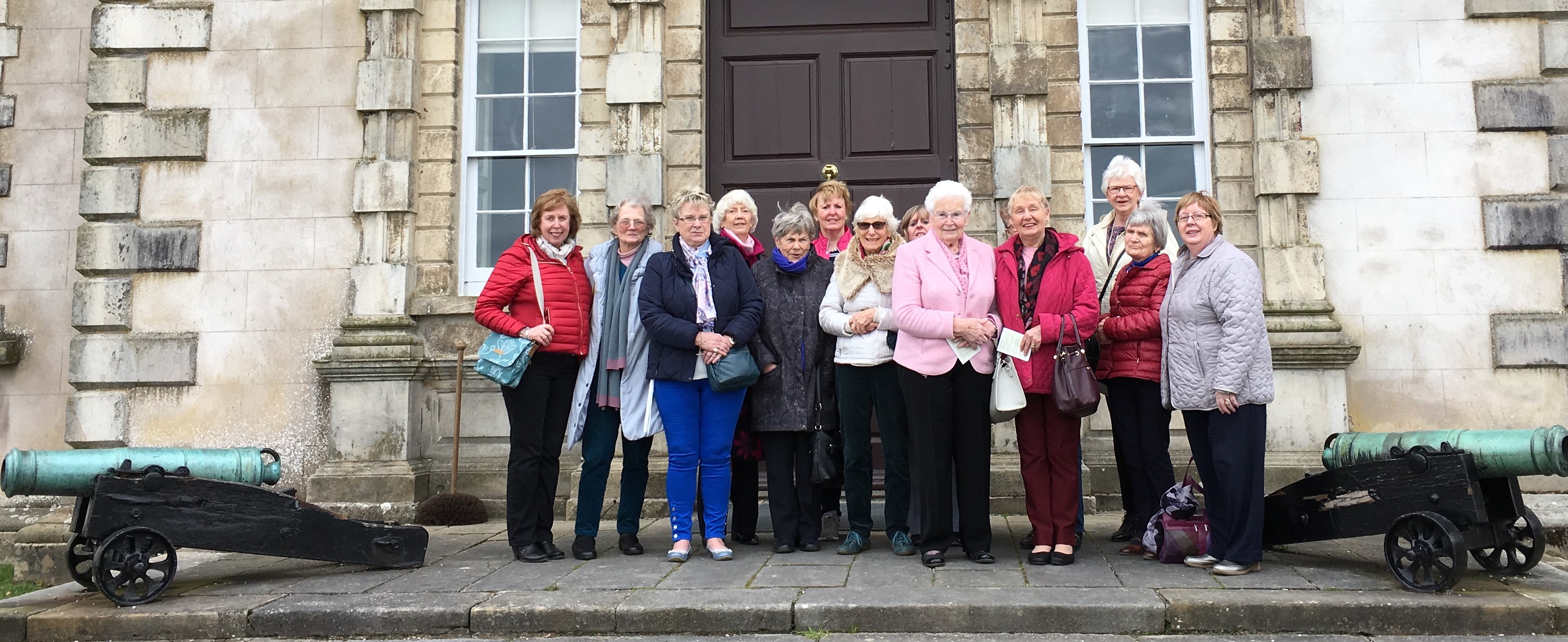
Since the April meeting of Omagh Ladies’ Probus fell during during Easter week this year, a Spring outing to National Trust Property Florence Court House was arranged.
The ladies enjoyed a walk through the grounds followed by a very interesting and informative guided tour of Florence Court House, an impressive 18th century residence which was formerly the home of the Earls of Enniskillen until 1973.
In addition to observing the classical architecture with exquisite Rococo plasterwork and hearing of the history of the building, they were entertained to snippets of the Cole family history and reflections of life above and below stairs in this impressive residence.
The outing concluded with a visit to the Estate tearoom for refreshments.
The next Ladies’ Probus meeting will take place on Thursday 3rd May in Omagh Library at 2pm when the speaker will be Mrs. Anita Robinson.
Wednesday 4 April 2018: Mr Geoffrey Simpson: Antiques and Antiquities
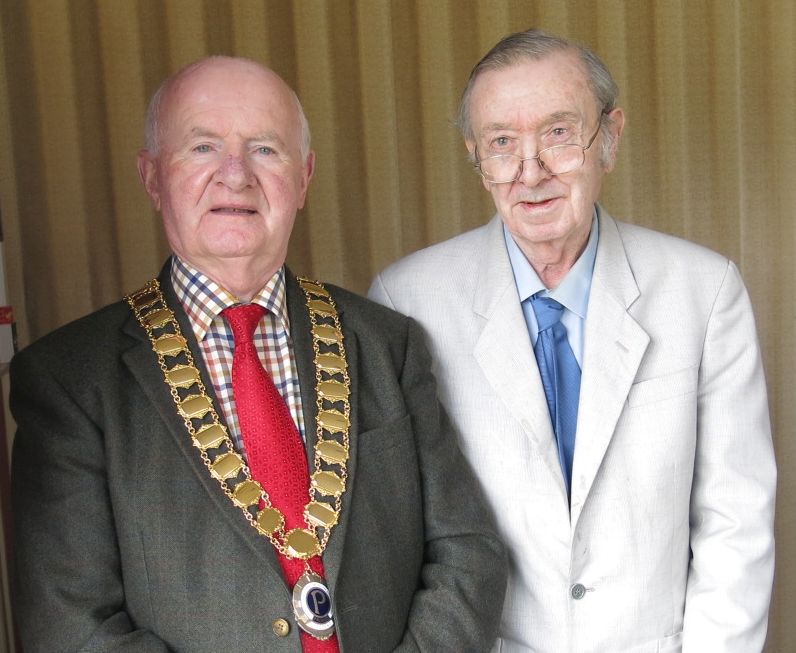
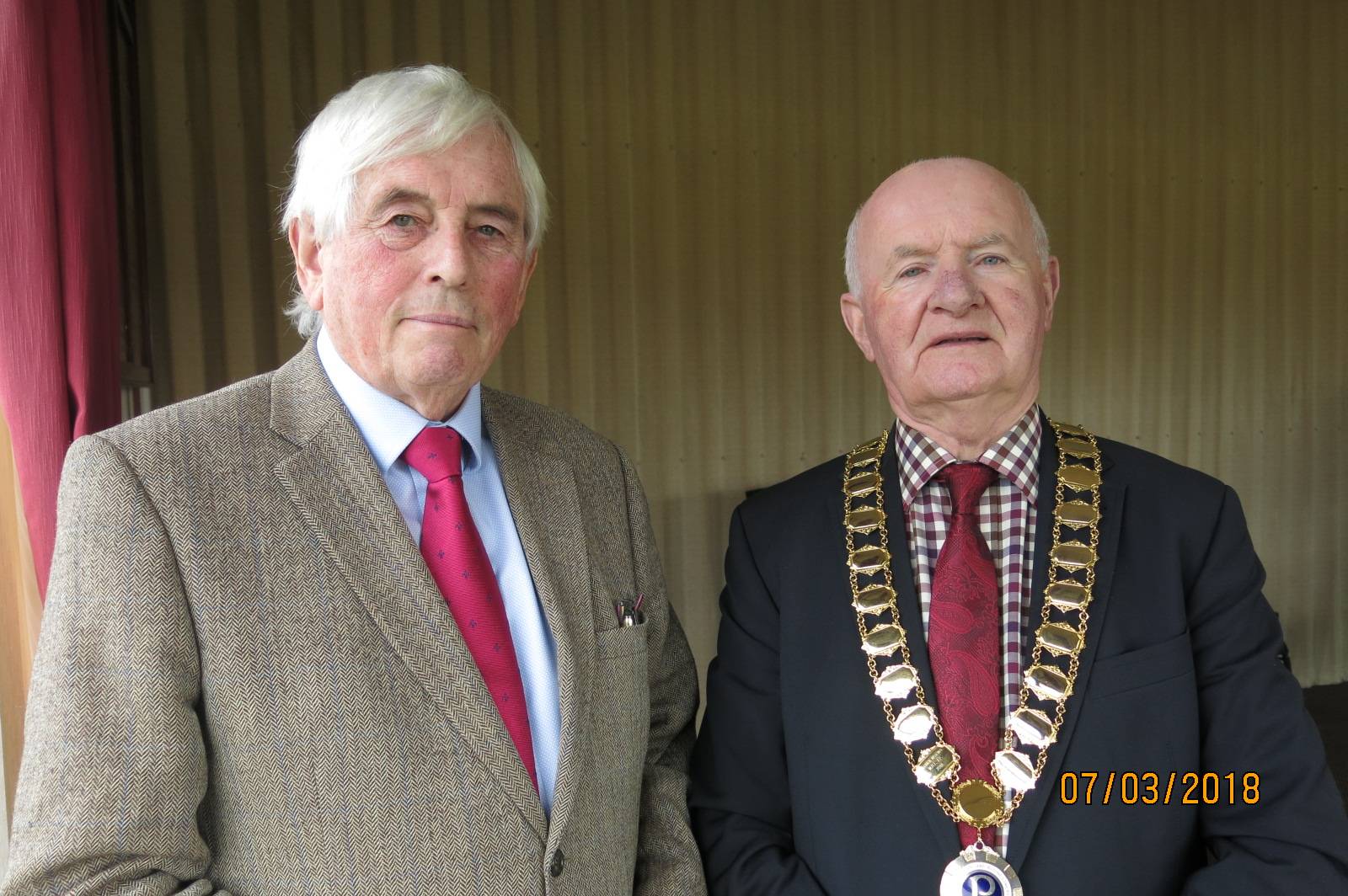
Probus President, Paddy McGowan [left] with guest speaker, Geoffrey Simpson
Geoffrey began his talk by literally blowing his own trumpet – in this case a bronze age ox horn some 3000 years old. This gave him the opportunity to explain that his interests are in both Antiquities [items that are very old] and Antiques [items around 100 years old]. He had brought with him a number of objects of both types and started by passing round a 200 million year old fossil from the Jurassic Period. Common in the Lias Clay beds on the Antrim coast it was thought to be one of the Devils Toenails before being properly identified as an early mollusc. This exhibit was followed by a polished segment of dinosaur jawbone [complete with teeth] before showing off some stone-age axe heads crafted from volcanic porcellanite and flint. The bronze age saw the arrival in Ireland of Celtic smiths and the first jewellery delicately worked in gold and bronze. Members were enthralled by a beautifully decorated gold ring from this period. Moving on to the modern era Geoffrey passed around a number of small items, the most intriguing of which was a tobacco box which once contained Dr White’s Glasgow Presbyterian Mixtureas smoked by the Rt Hon Stanley Baldwin; at least that is what it said on the tin. Other items included ivory pill boxes and snuff boxes, suddenly back in fashion in some quarters as receptacles for cocaine. He was thanked for a most interesting talk by Probian, Michael Cooney.
Wednesday 28th March 2018: Stephen McKenna: The History of Omagh
Guest Speaker, Stephen McKenna [right] with Club President, Paddy McGowan
Guest speaker Stephen McKenna took as his theme the history of Omagh. The name “Omagh” indicates a plain but the origin of Omagh is obscure. In jocular mood Stephen said a hermit resident in early Omagh described it as “a den of thieves and robbers” and a papal envoy travelling through the area was quoted as saying that he “couldn’t get out of it quick enough”. The early town had a Franciscan Friary located behind the Hogg’s Head pub. The 150 monks there provided various social services to the local community but with the collapse of the O’Neill dynasty the friary also came to an end. In 1768 Omagh became the county town of Tyrone. Construction of the Courthouse, completed in 1824, added to the importance of the town as an administrative centre. Also, in the nineteenth century, schools were established, hospitals built, and the town connected to the railway system. The 1880’s saw the first substantial buildings of St Lucia barracks constructed. Lisanelly camp was developed during World War II. Three of the main church buildings, the Methodist church, the Presbyterian Meetinghouse on the Dublin Road and the Catholic church were all replaced with new buildings close to their original sites. Stephen said Omagh can claim to be a cultural centre and he enumerated a number of writers, poets, musicians and actors of note who were or are from the town. It is a cosmopolitan and liberal town and has much to be proud of.
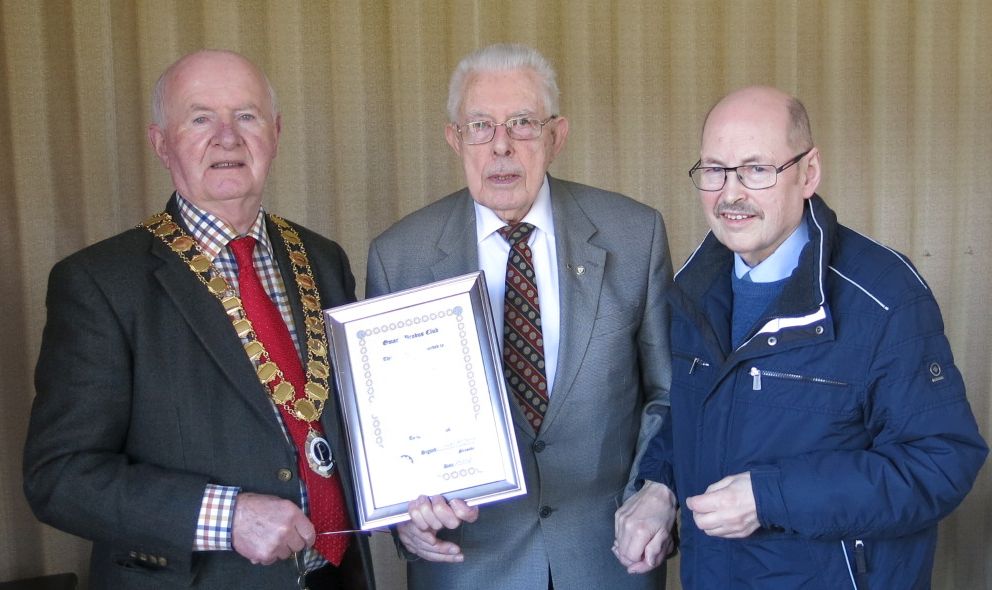
At the same meeting long-serving club member, Pat McCaul, was presented with his Honorary Membership Certificate, it being the custom of the Club to confer Honorary Membership on Probians who have celebrated their 90th birthday.
Club Member, Pat McCaul receiving his Honorary Membership Certificate from Probus President, Paddy McGowan [left] accompanied by Club Secretary, Gerry McGonigle
Wednesday 21 March 2018: Anthony (Tony) Brogan: Teaching in Uganda in the ’60’s
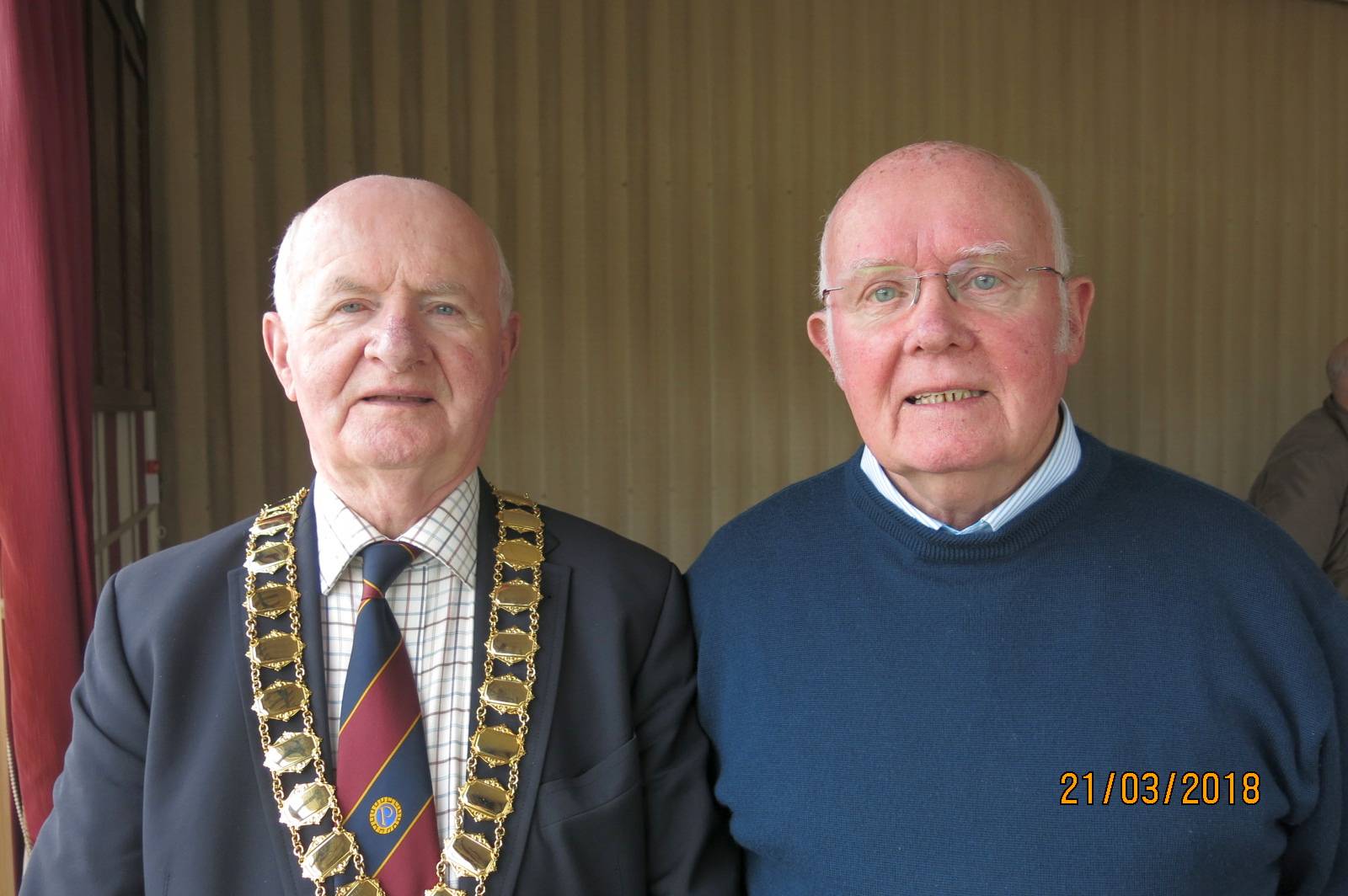
Probus President, Paddy McGowan [left] with guest speaker, Anthony Brogan
Shortly after graduating from the Queen’s University in 1965 with a degree in English, Tony, a former pupil of Omagh CBS, got married. Part of his honeymoon with his new wife, Mary, was a flight to Uganda on a BOAC VC10 airliner en route to a teaching post in St Edwards CBS in Mubende. He recalled that the first part of the journey from the airport to the school was on a paved road which became an increasingly bumpy dirt track as they penetrated deeper and deeper in to rural Uganda. The school was soundly constructed from baked red earth bricks but otherwise rudimentary. The bigger surprise was that he and his wife were the only white people on campus, all other students and staff belonging to local tribes. Tony began his talk to Probus with a Geography lesson, holding up a map of the world to show where Uganda was and sketch map of Uganda to show its location in East Africa. Back in the 60’s most Ugandans were peasant farmers bartering their produce in the local markets in what was largely a cashless economy. During his interesting talk Tony touched on local culture and customs including the influence of witch doctors and tribal chiefs. After 6 years in the tropics he returned home to take up a teaching post in his old school. His final anecdote was about an old country woman in rural Ulster who imagined that his three children would be black because they were born in Africa.
Club Member, Hugh Ward [left] with Probus Vice-President, Oliver Loughran
Club member, Hugh Ward, stated that his purpose was to encourage those who had aspirations to fill in a family tree not to be deterred because there was plenty of help and practical advice. Various pro formas were available on-line including one published recently by the Belfast Telegraph. He distributed a simplified construct with spaces for three generations that would likely cover the first 100 years of family history. But where to start? He recommended talking to the oldest members of the family and using photograph albums to write down as many names as living memory provides. Church and parish records in many places go back to 1864 providing records of births, deaths, and marriages. The Griffith Evaluation, commissioned in the 19th century for purposes of rural taxation, today shows who owned or rented every field and farm in the country. It is available on-line. The first census in Ireland was conducted in 1821 and every 10 years thereafter except the record is not complete due in part to the burning of the Public Record Office in Dublin in 1922. Old school roll books, many now housed in the Northern Ireland Public Record Office are worth examining as are back copies of local papers, now available in microfilm in local libraries. Tombstones in graveyards can also be revealing as can local histories. The most recent aid to researching family trees is DNA testing which reveals not just your genetic composition [e.g 4 parts Irish, 1 part Norse] but also how many members of your extended family are already on the DNA database. Hugh’s talk was very well received and gave rise to much discussion.
Oliver Loughran [Left] with Probus President, Paddy McGowanWednesday, 7 March 2018. Oliver Loughran: The ’50’s Music Scene
Probus Vice-President, Oliver Loughran chose as his topic his involvement with the Music Industry in Ireland in the days of his youth. Much of what he recalled resonated with members and evoked their own memories of listing to Radio Luxembourg. As a teenager growing up in Ballygawley, attending Omagh CBS, opportunities to go to dances listen to live music were limited. The annual Music Carnival organised by the parish in Ballygawley to raise funds was an exciting event in the late ‘50’s, especially if the Melody Aces were playing. He recalled a Fordson tractor parked behind the hall to power the generator for the amplifiers and hearing the tractor between the numbers. The local music scene in those days was dominated by early showbands such as the Clipper Carlton and the Quigley Band. On arrival at Queen’s University in 1961 Oliver and some friends formed their own band in which he was the drummer. Their reputation on campus grew and memorable gigs included rag week concerts compered by Bob Monhkouse and Des O’Connor. In their final year at university the band appeared on stage in the Ulster Hall supporting big name bands such as the Royal Showband and the Capital Showband. After his talk others were keen to add their own reminiscences of the showband era and the meeting ended with humorous anecdotes of loves lost and won at dances in Tyrone and Fermanagh.
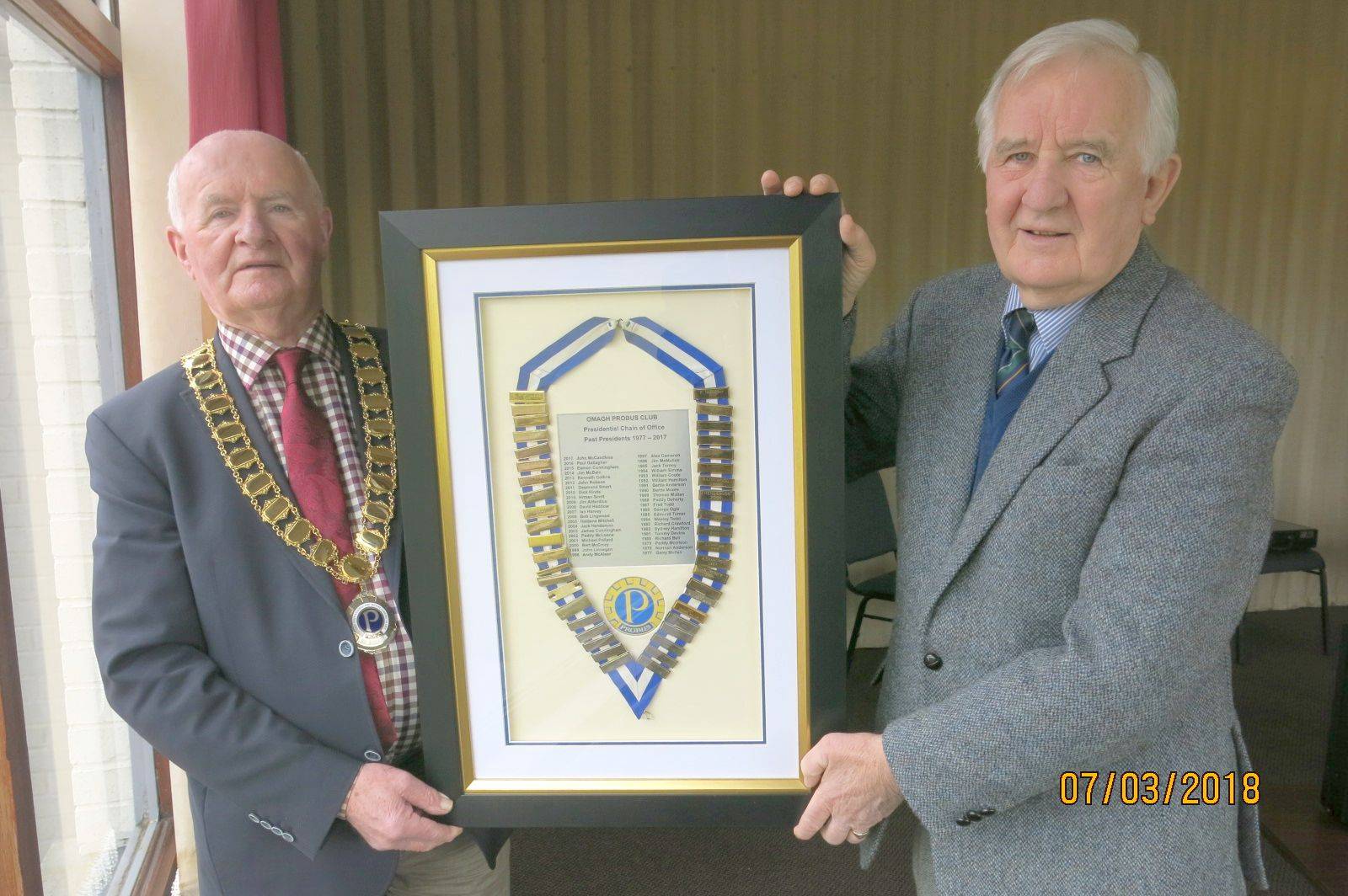
Probus President, Paddy McGowan [Left] with Immediate Past President, John McCandless, receiving former Presidential Chain framed for display in the Club.
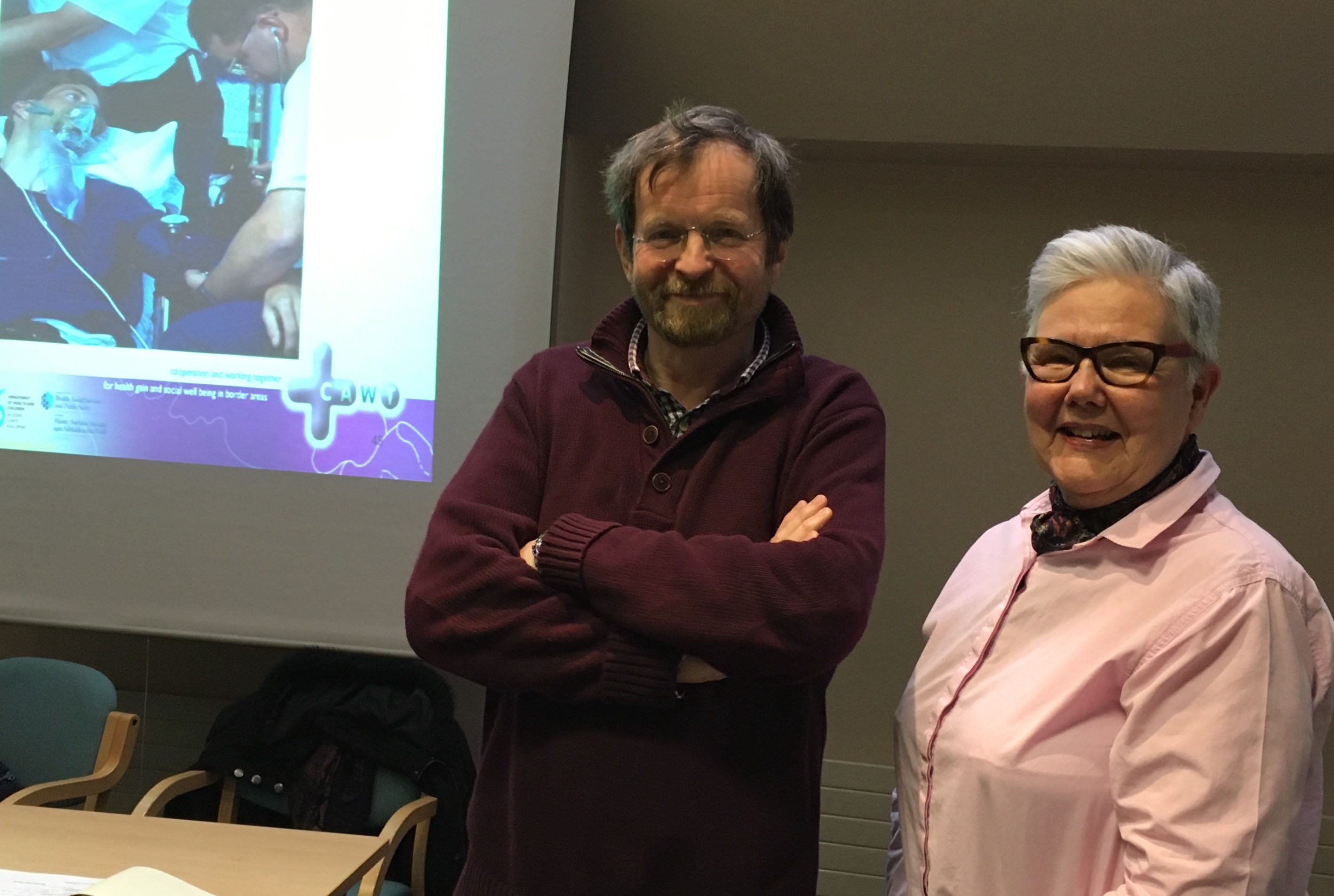
“Would you gamble your life on a takeaway meal?” was the dramatic and thought provoking title of an audiovisual presentation shown to Omagh Ladies Probus members at the March meeting of the club.
Vice President Zoe Reid extended a warm welcome to guest speaker Dr. Ian Leitch whose interest in food allergens and the problems encountered by sufferers when purchasing food was sparked off at a Public Health conference in Canada many years ago and has led to many years of research on his behalf.
Dr. Leitch explained that for many allergy sufferers purchasing and eating prepared food without full knowledge of the ingredients used was indeed a gamble. Hidden allergens in seemingly suitable dishes had the potential to trigger a life threatening reaction and cases of deaths resulting from this have been documented.
In 2006, a N. I. Research Project highlighted this problem when samples of food purchased for peanut allergy sufferers showed that one in five of the catering premises visited provided meals which could possibly have triggered a fatal reaction!
Further research on the need for allergen controls being put in place led to awareness training programmes for Environmental Health Officers being set up.
Members were reassured to hear that much work has been done since then and more stringent safeguards are now in place. From December 2014 all food businesses have been required to provide allergy information on food sold unpackaged.
With restaurants needing to be able to supply up front information on allergens on menus etc. eating out is less of a gamble for many susceptible people.
In his very comprehensive talk, Dr. Leitch referred to the better known allergies, their symptoms and treatment options including the use of an EpiPen. With over 170 known food allergens and the number of allergen sufferers rising, it was encouraging to hear of the work done within the food industry to label ingredients clearly.
Club member Audrey Hodge thanked Dr. Leitch for being generous with his time and for his interesting and informative talk.
Omagh and District Ladies’ Probus Members will take part in a Spring Outing to Florence Court National Trust Property on Thursday 5th April.
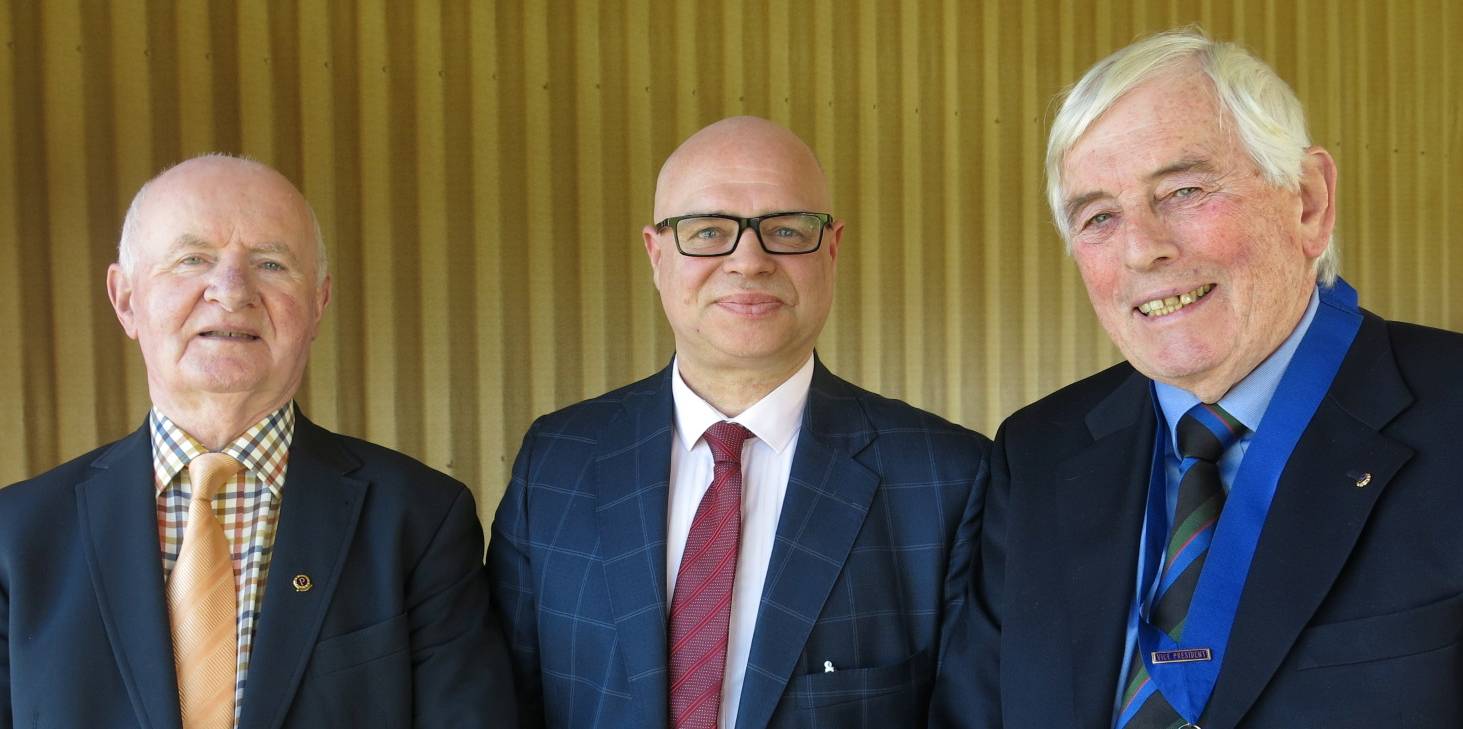
[L – R] President. Paddy McGowan, Mr Donald Pottie and Vice-President, Oliver LoughranWednesday 21 February 2018. Mr Donald Pottie: Effective Legacy Planning
A D Pottie & Co is a firm of Chartered Accountants and Business Advisors based in Fintona, specialising in Effective Legacy Planning for farmers and all who have property to pass on. Effective Legacy Planning is about getting good advice, considering everything that could affect your wishes and being aware of all your options, so that you can make your own informed choice. Using members of the club as an imaginary family he introduced a Mum and Dad, a Son and Daughter, a Merry Widow and a scurrilous suitor. This set-up allowed a lighthearted look at some serious issues regarding wills and inheritance. Having touched on matters such as Probate, Trusts and Powers of Attorney he then invited questions. Club members were prompt to use the opportunity to check out their own understanding of Inheritance Law and glean more information. This opened up other avenues of inquiry such as how to prevent sideways disinheritance, what happens if beneficiaries die prematurely and preventing successful challenges to wills. It was Mr Pottie’s opinion that using a Trust is the most flexible yet robust method of ensuring that your assets are protected during your lifetime, your wishes respected when you are gone and your loved one’s inheritance will not be lost or reduced. He was thanked for his interesting and informative talk by Probus President, Paddy McGowan, seconded by Jim McBain
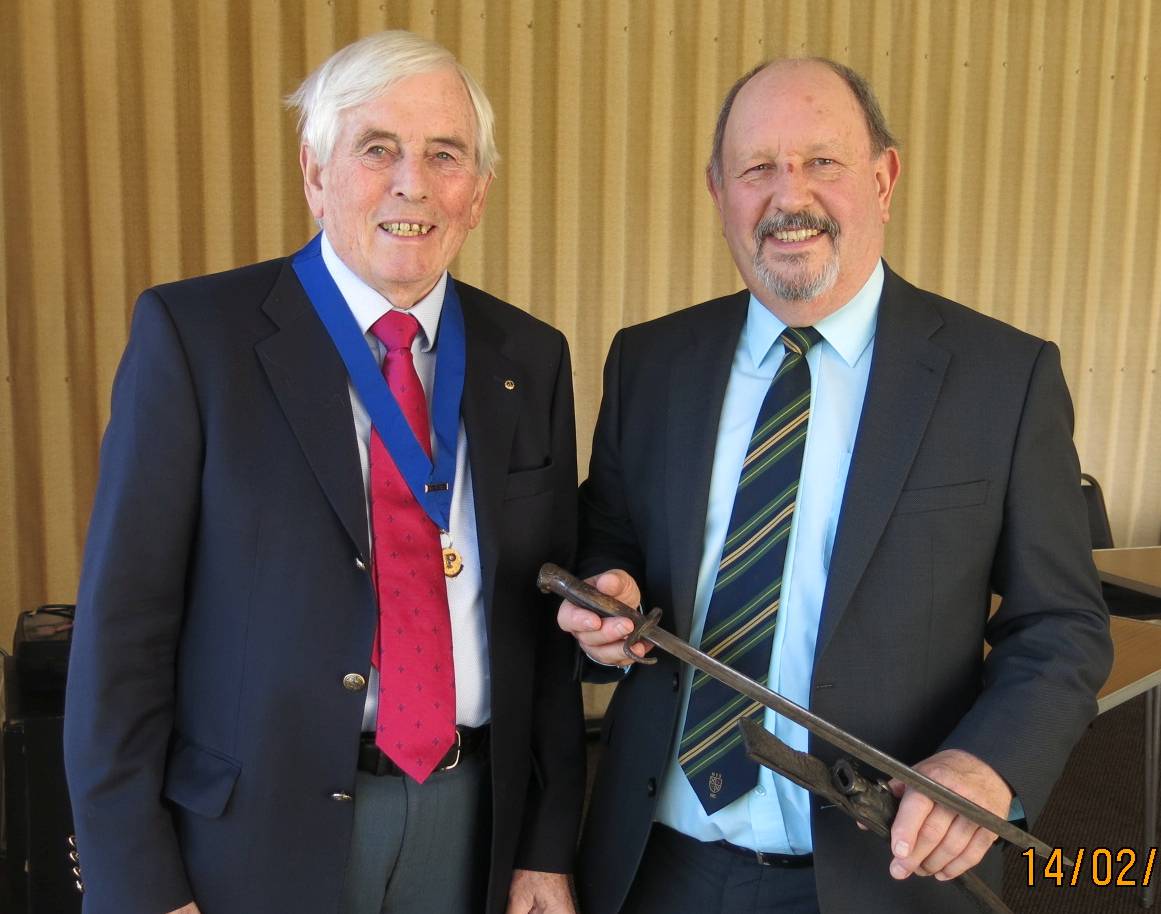
Wednesday 14 February. Mr Philip Faithful: The Abington Collection
Probus Vice-President , Oliver Loughran [left] with guest speaker Philip Faithful
Philip opened his talk by explaining that he began collecting at the age of 14 and 50 years later is still at it. He has now over 7500 items in his collection, including classic cars, motor cycles, Raleigh Choppers, juke boxes and radios, die-cast models and rooms filled with militaria from both sides of the conflict in both World Wars. His collection is open to the public by appointment and attracts some 2000 visitors each year. There is no admission fee but contributions are gratefully accepted in aid of Cancer Research. To date he has raised over £30,000 in memory of his father who died from cancer in 1988. Philip brought with him a number of items from his collection including a rare bayonet from the Boer War. He has over 500 bayonets most of which were designed for the Lee Enfield rifle on the First World War. From the same period of history he has several military medals including a World War I “Death Penny”. Philip researches each piece carefully to establish its provenance. However a photograph of a young woman in World War I uniform remains a mystery. The name on the frame is Miss Ella Laird, 2 Dergmoney Place, Omagh and Philip would love to hear from anyone who can provide more information about her. Tel 028 8224 3373
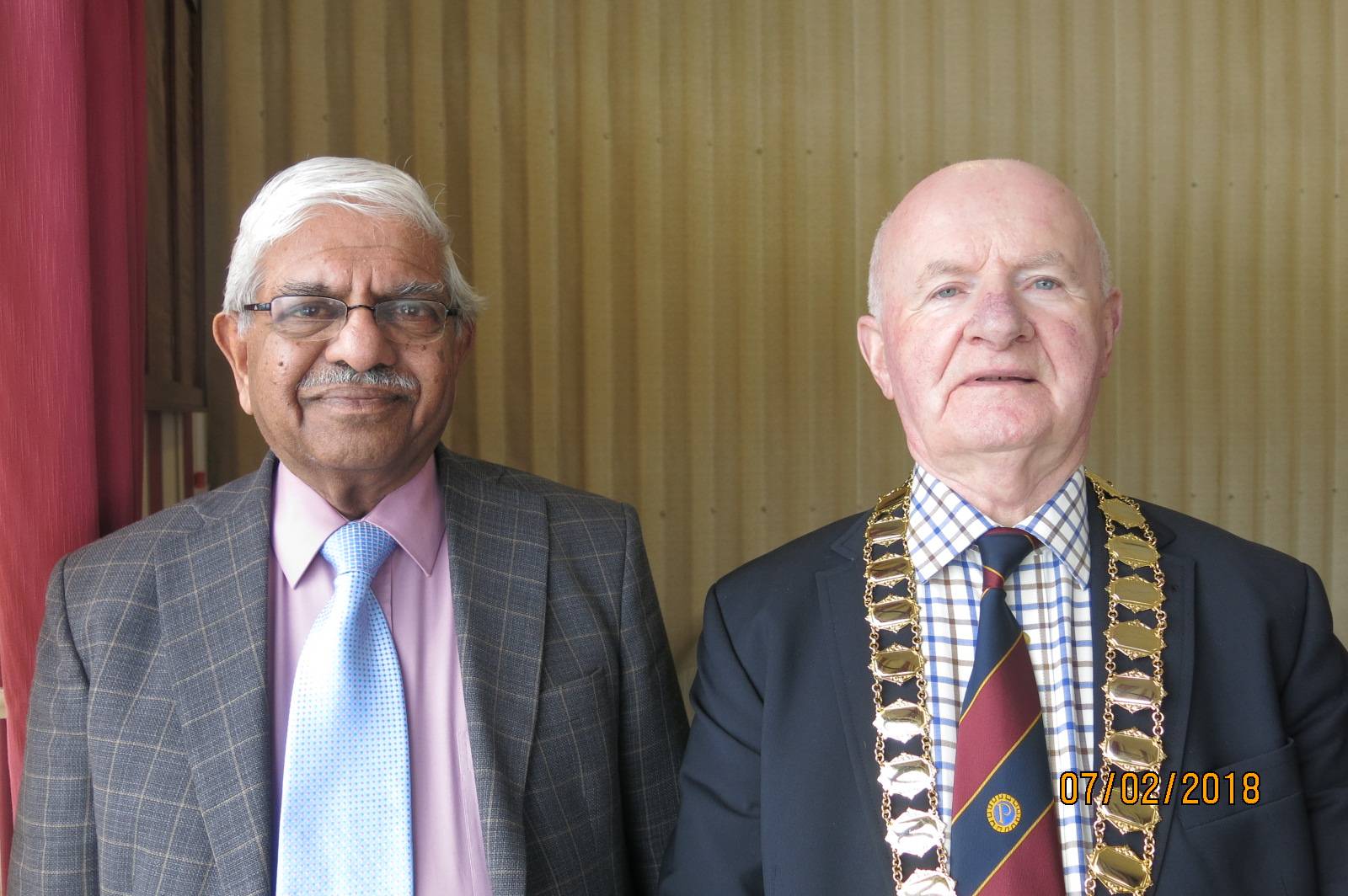
Mr Pinto OBE [left] with Mr Patrick McGowan MBE, JP, Probus PresidentMr Pinto provided members with an enthralling talk on his background in medicine and his time as a Consultant Surgeon in Tyrone County Hospital. A native of Goa he studied medicine in London and at Cambridge and upon graduation embarked on a career in academia. Having set up a post-graduate course for surgeons in Uganda he returned to Britain to do pioneer work for the Medical Research Council on transplant surgery and CAT scans – both at an early stage of development. After eight years in this role he felt drawn back to “hands-on” surgery and applied for the first hospital post advertised. It was in a place he had never heard of, in country he had never visited – Omagh, Northern Ireland. Encouraged by a colleague in Queen’s University, Belfast, he applied for the post of Consultant Surgeon in Tyrone County Hospital and [as they say] the rest is history. Mr Pinto then charted the development of medical services in TCH from the time of his arrival until its closure in 2017. During that time A & E services were up-graded, new specialisms introduced, new wards added, new theatres constructed, a new sterilisation suite commissioned, new staffing structures introduced and post-graduate centre erected. While he regretted the closure of Tyrone County Hospital he was positive about the new hospital and its focus on day procedure surgery . It had, he noted, already acquired a reputation for the sort of clinical excellence that had been the hallmark of Tyrone County Hospital.